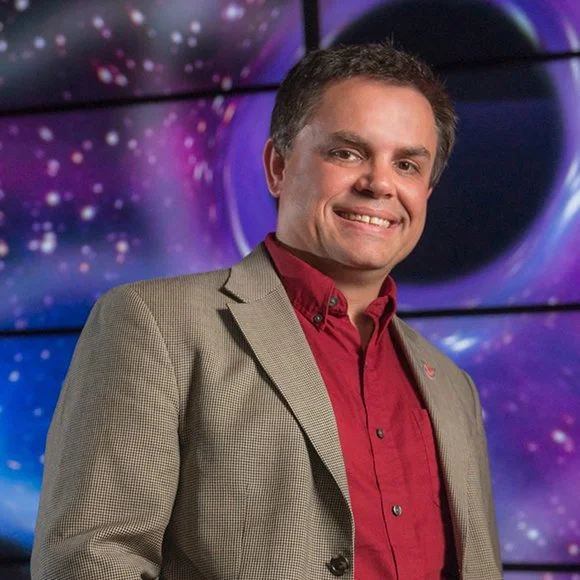
Dr. Shane Larson
Shane Larson is a professor of Physics at Clarkson University and the Director of Integrated Engineering and Applied Science Projects. He works in the field of gravitational wave astrophysics, specializing in studies of compact stars, binaries, and the galaxy with both the ground-based LIGO project, and the forthcoming space-based observatory LISA.
He is an award winning teacher, and a Fellow of the American Physical Society. He is an avid amateur astronomer, observing with two homebuilt Dobsonians, a 12.5" named EQUINOX and a 22" named COSMOS MARINER.
He contributes regularly to a public science blog at writescience.wordpress.com, and posts at Bluesky with the handle @sciencejedi
Topic: The Women of the Harvard Computers and the Birth of Modern Astronomy
Only 125 years ago, we knew very little about the Universe. We knew virtually nothing about the stars. We didn't know why they looked different colors, how they were born, what made them shine, or how they died. Moreover, we knew virtually nothing about the Milky Way or the nature of the Universe itself. We didn't know how big it was, how old it was, how it was changing over time, nor what all the things we could see in telescopes really were.
Bigger and better telescopes were being planned and built, and universities were growing groups of professional astronomers to try and make sense of the Cosmos. Among these was the Harvard College Observatory which in the late 1800s and early 1900s employed a remarkable group of women now known as the "Harvard Computers." Over the course of a brief couple of decades, these women literally transformed the nature of modern astronomy, making discoveries that defined how we use and interpret astronomical data to the modern day.
In this talk we'll discuss the state of astronomical knowledge in those days, the members of the Harvard Computers and some of the discoveries they made, and how they are indeed the founders of modern astronomy.